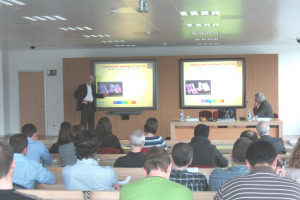
The first working session was given by Prof. Doru Stefanescu (University of Ohio, USA), speaking about the equilibrium thermodynamics of iron-based alloys and introducing the complex configuration of solidification processes through the nucleation and growth of primary austenite, graphite and eutectic phases. The second part of his conference was orientated to present the latest advances in simulation, aimed at developing models to predict the mechanical properties and micro-shrinkage in cast components.
Dr. Ing. Jacques Lacaze (CIRIMAT-CNRS, FRANCE) focused his presentation on the heat transfer and metal solidification. The study of heat flow in high-temperature processes has significantly improved the control of solidification and the quality of the final parts (macrostructural and microstructural features and hence the mechanical properties of the casting).
The temperature distribution in the melt should be accurately known throughout the solidification process. The values obtained in the interface transfer coefficient can greatly differ and they are dependent on a large number of solidification variables. The different heat transfer mechanisms at the metal/mold interface during solidification have been described along this interesting presentation.
Dr. Ing Gérard Lesoult (Ecole des Mines de Nancy, FRANCE) made an interesting presentation on the quality of semi-processed products (continuous casting and steel ingots) and various cast components (iron, Ni-base super alloys and aluminium).
The second part of his lecture was focused on the development of microsegregations and the various theoretical principles and development of micro shrinkage and micro porosity defects.
Dr. Ing Ignacio Alfaro (R&D Manager of Befesa Aluminio, S.A.) stressed throughout his conference the need to consider environmental factors associated to the different process technologies for the transformation of metallic materials (specially within the foundry industry). He shared with the attendees the current situation on the waste generated along these processes, and the big amount of opportunities for recovery and recycling of waste foundry materials (well identified as by-products, instead of as waste materials).
After a thorough analysis of the different by-products (fines, sweepings, slag, foams, refractory materials, sand, carbonaceous components, metal returns, plates, chips, scraps, …. etc), Mr. Alfaro presented different recovery technologies with a detailed description and reference to the recycling of aluminium residuals.
The main feature of secondary aluminium (today recycled aluminium accounts for one third of global aluminium consumption world wide) is its energy reserve. Recycling is nowadays an essential part of the aluminium industry from the economical, technical and environmental point of view. At the end of their useful life, all aluminium products retain some worth, which guarantees that it is possible to create value by recycling them into new products. Efficiency of aluminium recycling thus translates into high recycling rates for the various applications.
The last working session was given by Prof. Doru Stefanescu (University of Ohio, USA) and it was aimed at the processing and properties of lightweight Ductile Iron castings.
Prof. Stefanescu has led over the last 10 years outstanding research projects focused on developing manufacturing technologies for light weight ductile iron components (down to 2.5 mm in thickness), some of whose experiences were presented during his conference, along with practical cases and results.
Issues related to internal soundness, mechanical properties and the surface quality/finishing on cast components of these characteristics were discussed during this extraordinary conference.