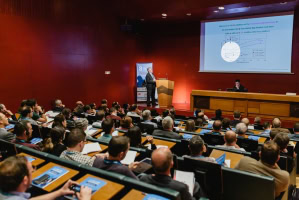
Organized by the IK4-AZTERLAN Metallurgy Research Center, along with the American Foundry Society (AFS), the World Foundry Organization (WFO) and the Tabira Foundry Institute, this outstanding international framework has reviewed the metallurgy fundamentals of cast iron by sharing some of the latest research and technological developments for the industry. The event has also outlined some of the opportunities for this material that keeps giving response to high-demanding applications in sectors like automotive and energy, among others.
By an outstanding working program formed by 40 technical presentations, experts and technicians from the industry and the academia have discussed the latest innovations aimed at improving the efficiency of industrial processes, optimizing tooling design and enhancing physical and mechanical characteristics of alloys and components, as well as their resistance to corrosion, oxidation and wear, among others.
The 4 Invited Key Note Lecturers have presented innovative experiences related to cast iron materials and processes, as well as a market-oriented vision on the evolution of cast iron components in the automotive sector and the energy sector.
The first of the guest speakers, Mr. Jorge Fesch, CEO and President of SAKTHI PORTUGAL, has shared with attendees to the Symposium the importance of incorporating innovation into the corporate culture of the foundry.
With a view closer to the product development, Mr. Per Samuelsson, Head of Metallurgy at MAN Energy Solutions, has presented a case study on how a casting of compact graphite was used to build cylinders for heavy duty marine engines.
The Symposium has offered the chance to share the vision and strategy of the automotive industry regarding this material, through the presentation of the company RENAULT as a reference European car manufacturer. Mr. Loïc Vaissiere and Mr. Eric Albertalli, experts in foundry materials and technologies, showed the attendees evidence of how the weight lightening strategies implemented by the industry, transitioning towards the gasoline engine and the “imminent and inevitable” jump to the electric engine, represent a steady reduction in the presence of cast iron components in the high volume passenger vehicles.
As a very interesting counterpoint to this vision, Dr. Steve Dawson, CEO and President of the company Sintercast, has blamed “miss-communication by the casting industry and by the automotive industry” for the decrease of cast iron parts in cars. By showing a complete life cycle analysis of the components, the Sintercast representative has shown that the incorporation of aluminum as a substitute for iron casting fosters a CO2 emissions increase resulting from the environmentally unfriendly production and processing of this metallic material.
The memory and the figure of Dr. Carl Loper have been present throughout the Symposium. During the opening and closing ceremonies, through the technical presentations of many speakers and in some of the social events, words and anecdotes about the late Dr. Loper have been shared. He has been defined as a prolific researcher, “professor of professors” and an international reference in the field of iron metallurgy.
The Organizing Committee for the event wants to highlight and appreciate the collaboration and involvement of a good number of companies (not only from the auxiliary sector, but also foundries), which have supported this international framework through their sponsorship: HA ILARDUYA (gold sponsor), ASK Chemicals (silver sponsor), DRAXTON (silver sponsor), SQ INSERTEC (silver sponsor), FOSECO (bronze sponsor) y HA GROUP (Gala Dinner sponsor), as well as the support of the Education Department of the Basque Government.