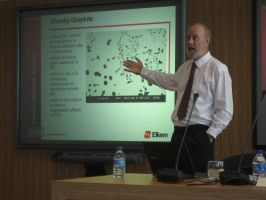
After a short introduction of the company ELKEM AS done by Mr. Gonzalo Basterra, the first technical conference shared among the audience some basic inoculation concepts for grey and nodular iron
Mr. Chris Ecob made a brilliant presentation on the graphite nucleation mechanisms during solidification, explaining the most impotant effects of inoculation in the cast components. He explained as well some of the most important factors that influence the conditioning of the iron, finishing this first communication with some interesting comments on the most convenient inocualtion practices for grey and nodular iron.
The second technical conference was orientated to go over some of the most common metallurgical defects in ductile iron, such as, graphitic malformations (chunky, spiky, …), exploded graphite, graphite flotation, shrinkage defects, inclussions, pinnholes, ferrite/perlite, ……
After a detailed analysis from each defect, Mr. Ecob shared possible root causes and working lines in order to solve such metallurgical deviations.
The following presentation was focused on the importance of the preconditioning of the iron. Mr. Ecob shared some of the latest investigations performed by the company ELKEM AS, that have come out with the development of a new product with new active elements that optimise the pre-conditioning properties of the metal. This presentation finished with five different application studies on real industrial practise.
Mr. Julian Izaga (Technical Director of AZTERLAN Metalurgical Technical Centre) finished the technical meeting with an interesting presentation on thermal analysis, sharing with the audience the importance of optimising the metallurgical quality of the iron. Thermal analysis is an indispensable tool for this optimization.
The interesting technical contents, along with the practical view on some industrial application experiences, made the working meeting fully successful.